

Drivers with at-fault accidents are far more willing to let an insurer monitor their driving than drivers with clean records. As many as 85% said they would consider it in exchange for a lower rate, compared with 55% of drivers with no tickets or accidents. Those numbers come from Jerry’s 2026 State of American Drivers survey of 1,500 U.S. drivers.
Overall, 60% of drivers said they would consider letting an insurer track their driving for a lower rate. But that figure doesn’t necessarily tell the whole story about usage-based insurance, which is that the people who volunteer for monitoring are usually the safe ones with nothing to hide. Here, the drivers most eager to be watched are often the ones with the most expensive records, and that could quietly reshape who ends up in telematics programs.

Jerry helps you save on car insurance fast.
What telematics programs actually do
Telematics, or usage-based insurance, tracks how you drive through a phone app or a small plug-in device. It usually measures the things most tied to risk: hard braking, rapid acceleration, speed, the time of day you drive, total mileage and phone use behind the wheel. The National Association of Insurance Commissioners (NAIC) notes that these programs can capture everything from mileage to hard cornering and even airbag deployment. Insurers feed that data into your rate, and most offer a discount just for enrolling, then adjust your price based on what the data shows.
Not every program works the same way, though, which is where the fine print matters. For example, some programs share all of your driving habits and data with insurers, but Jerry’s telematics program only shares your driving data with an insurer when doing so lowers your rate.
Key TakeawayTelematics ties your rate to how you actually drive. Most programs give a sign-up discount, but the details, including whether your rate can go up as well as down, vary by insurer.
Driving records and telematics willingness
Among drivers with an incident in the past three years – whether that’s a speeding ticket or an at-fault accident – 80% would consider monitoring, compared to 55% of drivers with clean records.
Although our survey didn’t ask drivers why they answered this way, a likely explanation lies in how insurance pricing works. A driver with a recent accident already pays a surcharge that can follow them for three to five years, so telematics offers a way to be judged on how they drive today instead. A driver with a clean record is already getting credit for that record and has less to gain by handing over more data.
Key TakeawayDrivers with a recent at-fault accident are the most willing to be monitored, not the least. 85% say yes to telematics, compared with 55% of drivers with clean records – a 30-point gap that flips the typical safe-driver assumption.
Willing when it’s optional, but not when it’s required
Drivers will accept tracking they signed up for but not when it’s imposed on them. A majority, 55%, said they would consider leaving an insurer that made monitoring a condition of coverage.
The objection isn’t to the data itself. It’s to not be asked about it. Nearly 50% of respondents were very uncomfortable with an insurer pulling their driving data from an outside source without permission, and 44% said automakers shouldn’t be collecting or sharing vehicle data at all – a concern regulators increasingly share after the Federal Trade Commission moved against General Motors for selling drivers’ location and behavior data without consent.
Jerry insight: Drivers draw the line at consent, not at tracking. Monitoring they choose is mostly fine, even among drivers with an accident on their record, but make it a condition of coverage and about 55% would consider switching insurers.
Who else says yes
Willingness to be tracked increases with time on the road, but decreases with age.
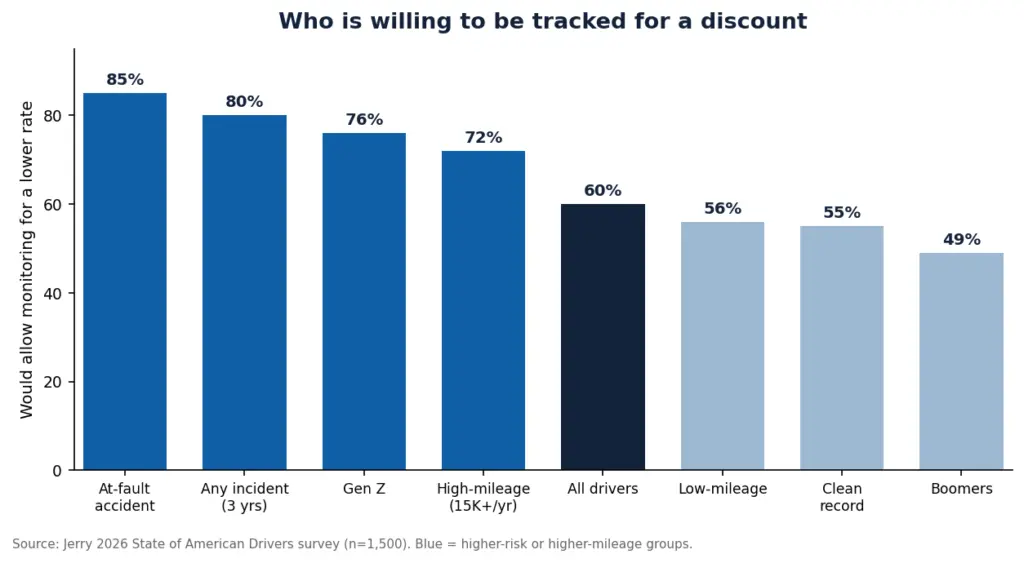
Over 70% of drivers who log 15,000 or more miles a year, about 23% of our survey respondents, would consider monitoring, against only 56% of low-mileage drivers. The generational split is even wider: 76% of Gen Z drivers would consider it, compared with just 49% of Boomers.
The more you pay, the more willing you are to be watched. High-mileage drivers and younger drivers pay the most for insurance, and they’re the most willing to trade data for a discount. Drivers who already pay little, including many older drivers, see less reason to opt in.
Jerry pulls up to 20 quotes from top rated carriers.
What this means for drivers and insurers
The drivers most willing to be monitored are the ones with accidents, tickets, high mileage or those in the age brackets that already pay the most, not the cautious low-mileage driver that telematics programs were built to attract.
This behavior has implications for carrier pricing. Insurers built telematics around the assumption that the people enrolling would mostly be careful drivers. If the riskiest drivers sign up instead, that group costs more than planned, and rates risk going up as a result.
Telematics prices observed behavior, though, so a driver with a past accident who now drives carefully and enrolls is the system working as designed. The open question is whether insurers can reprice current behavior fast enough to keep up with who’s enrolling.
For drivers, the takeaway is simpler: Most people will accept monitoring on their own terms, especially if they expect their driving to earn a discount. What they won’t accept is having the choice made for them.
Should you opt in?
Whether monitoring saves you money depends on how you actually drive and which insurer runs the program. Some track more than others, and with some, your rate can climb as well as fall.
That downside is the part Jerry’s own telematics program removes. Your driving data is only shared with an insurer when it can lower your rate, and never without you approving it first. You get the discount if your driving earns it, and nothing changes if it doesn’t.
Either way, start by finding out what you’d pay with no monitoring at all. Jerry compares quotes from 100+ insurers in minutes, including ones with and without usage-based programs, so you can make an informed choice about what carrier suits you best. Jerry also handles the switch for you, so the work of changing insurers becomes effortless.

It only takes 2 minutes to sign up at Jerry.
FAQ
- What is telematics car insurance?
- Can a telematics program raise my rate?
- Do insurers require driver monitoring?
- Who benefits most from usage-based insurance?