Compare car insurance quotes
Jerry is a free app trusted by 1,194,145 drivers nationwide that compares insurance quotes from top carriers.
-
Get personalized options in minutes.
-
Buy, bundle and switch right in the app.
-
Licensed agents are ready to help if you need them.

Ben Moore is a writer and editor at Jerry. He previously worked as a writer, editor and content strategist at NerdWallet, and has bylines in The Associated Press, Washington Post, Chicago Sun-Times, MarketWatch, Nasdaq and Yahoo News. He holds a bachelors degree in marketing from Olivet Nazarene University.
-
6 years covering auto insurance

Stephanie Colestock is a writer, CFEI®, and licensed insurance agent with over 14 years of experience specializing in personal finance topics like insurance, investing, retirement, and household budgeting. Her work has been featured in TIME, Forbes, USA Today, and other leading publications. Through her writing, Stephanie simplifies complex financial concepts, empowering readers to make smarter financial decisions.
-
Certified Financial Education Instructor (CFEI) (2024)
-
General Lines Agent, Property & Casualty (2025)
-
14 years as a professional writer and editor
-
10 years covering personal finance
Comparing car insurance quotes is the fastest way to lower what you pay for coverage. The same driver can get prices that vary by hundreds of dollars for the exact same protection, simply by checking more than one company. According to the Insurance Information Institute, shopping around and comparing quotes is one of the most effective ways to reduce your car insurance costs.
Jerry makes it easy to compare quotes from 50+ insurers in minutes, and over the last year drivers who switch have saved an average of $456 per year for full coverage and $1,629 per year for minimum coverage. Here’s how to compare quotes smartly.
Based on Jerry customers with clean driving records who found savings in the past 12 months. Savings depend on coverage and other factors. Potential savings will vary.
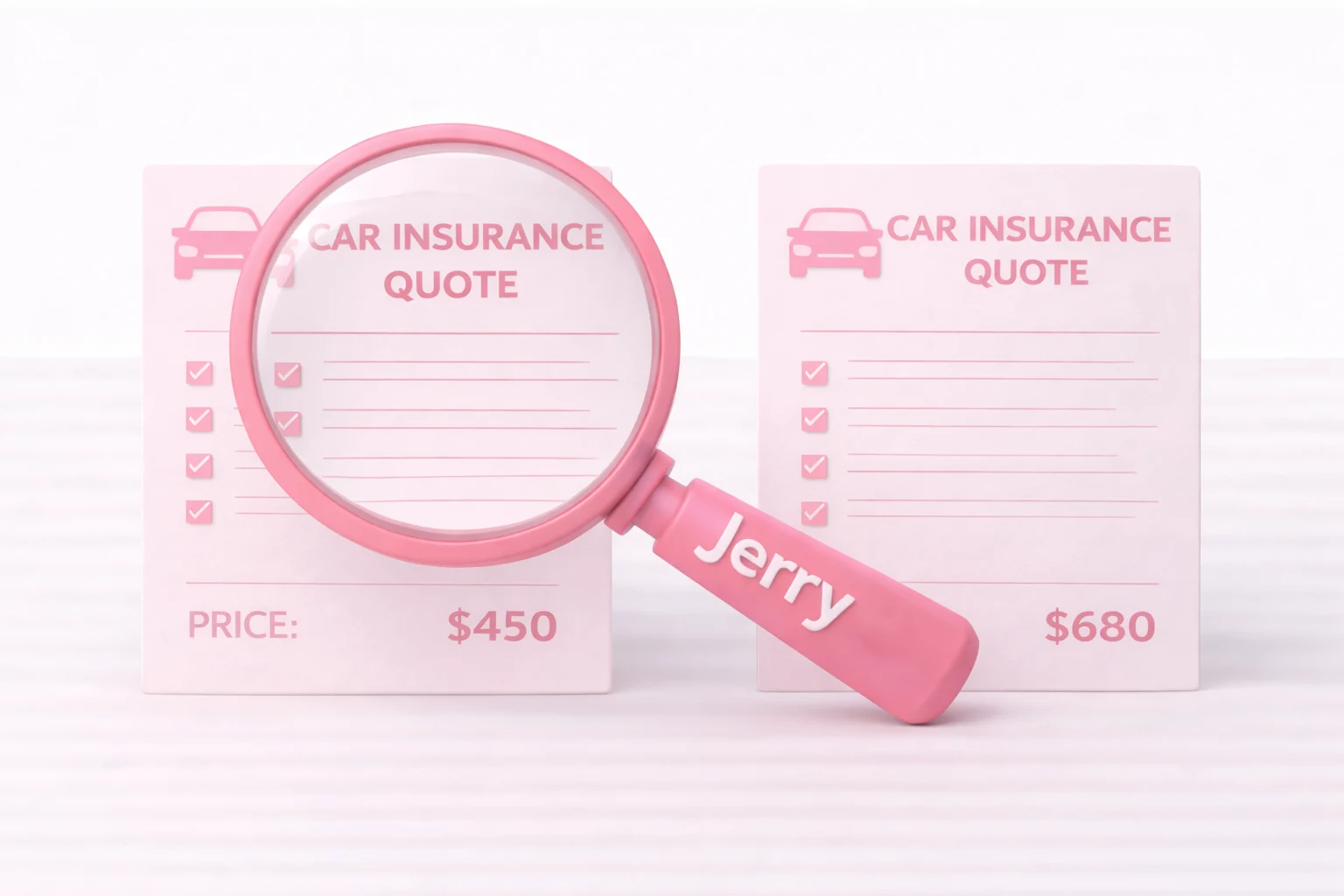
Jerry pulls up to 20 quotes from top rated carriers.
Why comparing car insurance quotes matters
Every car insurance company has its own way of calculating your price. They look at things like your age, where you live, what you drive and your driving history. But they each weigh those factors differently. That’s why the same driver can get different quotes for the exact same coverage.
Plus, car insurance prices have climbed every year since 2021, according to the Bureau of Labor Statistics.
With full-coverage car insurance costing between $181 to $406 per month according to Jerry’s customer data, and minimum coverage costing $78 to $177, it’s never been more important to make sure you’re getting a competitive price.
Based on Jerry customers with clean driving records who found savings in the past 12 months. Savings depend on coverage and other factors. Potential savings will vary.
Here’s why it’s worth a few minutes of your time:
-
Prices vary a lot between companies. The cheapest company for your neighbor may not be the most affordable for you, because every company weighs your profile differently.
-
Premiums change more often than you’d think. Insurance companies regularly adjust their rates, which means a great deal last year might not be very good today. If your car insurance went up at renewal, that’s not unusual, but it is a good reason to shop around.
-
Staying loyal isn’t a savings strategy. It’s easy to assume your current premium is still competitive, but the only way to know for sure is to compare. Shopping around is the fastest way to find out if there’s a better price out there.
-
Small savings add up. Even saving $50 a month puts $600 back in your pocket every year.
Key takeaway: Car insurance pricing is complex and changes often. Comparing quotes is the single best way to make sure you’re not paying more than you need to.
Compare car insurance quotes with Jerry
Shopping for car insurance used to mean visiting a dozen websites, re-entering your personal information every time and getting bombarded with phone calls and emails afterwards. Jerry changes all of that.
With Jerry, you can:
-
See quotes from 50+ top insurance companies in one place, in as little as two minutes.
-
Buy your policy entirely online. No phone calls, no paperwork, no pushy salespeople.
-
Bundle your car and home insurance by mixing and matching carriers to get the best combination of protection and price.
-
Keep track of market rates so you know when to reshop.
-
Chat with a real licensed agent whenever you have questions.
Get personalized car insurance rates now.
What you’ll need before you start
Having your information ready means you’ll get accurate, personalized quotes instead of rough estimates. Here’s what to gather before you compare.
The table below summarizes everything you should have on hand before comparing quotes.
| What you need | Why it matters |
|---|---|
| Driver’s license | Your license number and birthday. Include info for any other drivers on the policy (spouse, teen, etc.). |
| Car details | Year, make, model and VIN (the 17-character code on your dashboard or registration) for each car. |
| Current insurance | Your current insurer, what you pay, and what your policy covers. Your declarations page has all of this. |
| Driving history | Any accidents, tickets or claims from the past 3 to 5 years. |
| Home address | Your ZIP code alone can swing your rate by hundreds of dollars. |
| Coverage preferences | Do you want your state’s minimum or more complete protection? See Jerry’s guide on how much car insurance you need. |
Key takeaway: Before you start comparing quotes, gather your driver’s license, vehicle details (including your VIN), current insurance documents, driving history and home address. Having everything ready upfront means you’ll get accurate, personalized quotes.
How to compare car insurance quotes in 5 steps
Comparing quotes doesn’t have to be complicated or time-consuming. Here’s a quick and straightforward way to approach it.
1. Figure out how much protection you need
Every state requires you to carry at least a basic level of liability insurance that pays for damage you cause to other people and their property. But the state minimum is often not enough to fully cover you in a serious accident. Jerry recommends you to consider at least 100/300/100 in liability insurance, which gives room to cover most injuries and property damages.
Why does this matter? The National Highway Traffic Safety Administration (NHTSA) estimated that 39,345 people died in traffic crashes in 2024. Motor vehicle crashes cost the U.S. economy nearly $1.4 trillion in total societal harm, including $340 billion in direct economic costs. State minimum coverage often falls far short of covering expenses from a bad car accident.
If you’re still making payments on your car or leasing it, your lender will almost certainly require full coverage. This means your policy also covers damage to your own car, not just someone else’s. But even if you own your car outright, full coverage is worth considering if you can’t afford to fully replace it out of pocket.
2. Get quotes from multiple companies
This is the step that saves you money, but it can be time consuming. You need to see prices from at least three to five different companies to get a real picture of what’s available.
The fastest way to do this is with Jerry. Instead of visiting a bunch of different websites and entering your information over and over, Jerry lets you enter your info once and see quotes from 50+ insurers side by side, in as little as two minutes. You can compare, customize your protection levels and buy or switch your policy right in the app.
3. Make sure you’re comparing the same coverage amounts
A cheaper price is only cheaper if it’s for the same protection. When you look at your quotes, make sure that you are looking at:
-
The same liability limits. Coverage limits set the maximum your insurance pays out in case of an accident, so they should match across quotes for a fair comparison.. Limits are typically shown as three numbers, like 100/300/100. That means up to $100,000 per person for injuries, $300,000 per accident for total injuries and $100,000 for property damage. Jerry recommends 100/300/100 as a good starting point, since it gives enough room to cover most accidents without leaving you exposed.
-
The same deductible. This is what you’d pay out of your own pocket before insurance kicks in. A lower monthly price with a sky-high deductible might actually cost you more out-of-pocket if a minor accident like a fender bender occurs. Jerry customers most commonly pick a deductible between $500 and $1,000.
Tip: According to the Insurance Information Institute, raising your deductible from $200 to $500 could reduce your collision and comprehensive premium costs by 15% to 30%. Going to a $1,000 deductible can save you 40% or more. Just make sure you can comfortably afford to pay the higher deductible out of pocket if you need to file a claim. -
The same types of coverage. Make sure each quote includes the same protections, like comprehensive, collision, uninsured motorist coverage and so on.
Use this checklist to make sure you’re comparing apples to apples:
| What to compare | What it means | What to look for |
|---|---|---|
| Liability limits | Max payout for injuries and property damage you cause. | Match limits across all quotes (e.g., 100/300/100). |
| Deductible | What you pay out of pocket before insurance kicks in. | Same deductible on each quote ($500 or $1,000 is most common.) |
| Coverage types | Which protections are included (collision, comprehensive, etc.) | Every quote should include the same types of coverage. |
| Discounts applied | Savings for safe driving, bundling, paying in full, etc. | Ask each company which discounts are included in the quote. |
| Premium payment schedule | Monthly vs. 6-month vs. annual payment. | Compare the same payment schedule across quotes. |
4. Look beyond the price tag
The cheapest quote isn’t always the best deal. Before you decide, consider the full picture:
-
How does the company treat customers? Check reviews and ratings. You can reference our list of some of the best car insurance companies to see how they stack up. A low price doesn’t help much if the company is a nightmare to deal with when you need to file a claim.
-
What discounts are available? Ask about savings for safe driving, bundling your car and home insurance, paying in full, going paperless or even being a student. These can add up and knock your price down without sacrificing protection.
-
Is the company financially stable? You want to make sure the company actually has the money to pay your claim if something happens. Jerry only works with reputable, financially strong insurers.
Tip: You can check an insurer’s financial strength rating through agencies like AM Best, which grades companies on their ability to pay claims. A rating of A or higher means the company is financially strong.
5. Buy your new policy before canceling the old one
This is important: never cancel your current policy before your new one is active. An insurance lapse, even for a single day, can lead to higher prices down the road and may even be illegal in your state. Time your switch so your new policy starts the same day your old one ends. If you buy your policy through Jerry, we help cancel your old policy for you.
Jerry recommends: Compare quotes from at least three to five companies with the same coverage levels. Drivers who compare with Jerry save up to 63% per year.
What happens behind the scenes when you get a quote
When you request a quote, a lot happens on the other end, even if it only takes a couple of minutes on your screen. That’s because insurers use what’s called RC1 rating, where initial quotes are based on limited data. As more details are verified, the rate can shift up or down.
📊 Step 1: You get an initial estimate based on your basic info
When you enter your age, ZIP code, car and coverage preferences, the insurance company runs that through its pricing model to generate a first estimate. This number is based on what you’ve shared so far, but it’s not the full picture of who you are as a driver.
🔍 Step 2: The insurer starts verifying your info
Behind the scenes, the company begins pulling data to check what you’ve provided. Early checks typically include your claims history and, in most states, your credit-based insurance score. These initial reports help the insurer start building a clearer risk profile, and you’ll see a second, more refined quote that may be higher or lower than the first estimate.
💰 Step 3: The insurer pulls your driving record and locks in your final price
At this stage, the insurer runs its most in-depth check: pulling your motor vehicle report (MVR) directly from your state’s DMV. This report reveals your full history of violations and is the single biggest factor that can change your price at this point. Once this and any remaining verification is complete, you’ll see your final price — the number you’ll actually pay if you buy the policy. If your record is clean and your credit is solid, it might drop. If there’s something you didn’t account for, like an old ticket, it could go up.
Key takeaway: The first quote you see is an estimate based on your input. Your final price comes after the insurer checks official reports for your driving record, claims history and credit. Being upfront with your info from the start will help you avoid any surprises.
What affects your car insurance price
Insurance companies look at a lot of information when deciding what to charge you. Understanding what goes into your price can help you find ways to lower it, and give more clarity on why your car insurance might be so high.
The table below summarizes the biggest factors that affect what you’ll pay for car insurance.
| Factor | How it affects your rate |
|---|---|
| Where you live | Your state and ZIP code are some of the biggest factors. Drivers in some states pay two to three times more than drivers in others. |
| Your driving record | A clean record gets the best prices. Tickets and accidents can push your rate up significantly, and a DUI alone can nearly double it. |
| Your credit | In most states, insurers look at your credit-based insurance score when setting your price. Better credit generally means a lower rate. |
| Your age | Younger drivers pay the most because they have less experience. Prices usually drop as you get older, then rise again after 70. Senior drivers can still find competitive rates by comparing quotes. |
| Your car | Newer and more expensive cars cost more to insure because they cost more to fix or replace. Electric vehicles also tend to cost more. |
| How much you drive | The more miles you put on your car, the more you’ll typically pay. Low-mileage car insurance may be available if you drive fewer than 7,500 miles per year. |
| Coverage you choose | More protection costs more. But cutting corners can leave you financially vulnerable in a serious crash. |
Note on credit: The Insurance Information Institute reports that in most states, your credit-based insurance score is a significant factor in your premium. Improving your credit by paying bills on time and checking your credit report for errors could meaningfully lower your rate.
Key takeaway: Your location, driving record, credit, age and car all affect your rate. You can’t change everything, but comparing quotes is the fastest way to make sure you’re not overpaying.
When you should compare quotes
At a minimum, compare quotes every time your policy comes up for renewal. That’s usually every six months or once a year. But there are a few other times when it’s especially smart to shop around.
Compare car insurance quotes when:
-
Your renewal notice shows up. Don’t just auto-renew. Check if there’s a better deal.
-
You move to a new address. Prices can change dramatically from one ZIP code to another. For a more personalized estimate based on where you live, check out Jerry’s city and state insurance pages.
-
An old ticket or accident falls off your record. This usually happens after 3 to 5 years, and your price should drop.
-
You get married or divorced. Your marital status can affect your rate in most states.
-
A teen gets added to your policy. Adding a young driver to your policy can be expensive, and the price difference between companies can be significant.
-
Your credit improves. Many insurers use your credit-based insurance score as a factor in pricing, so a better score can mean a lower premium.
Jerry recommends: Don’t wait for a price hike to start shopping. Comparing quotes at every renewal is the best way to keep your rate competitive, and Jerry can help.

It only takes 2 minutes to sign up at Jerry.
faq
-
How much can I save by comparing car insurance quotes?
-
How long does it take to compare car insurance quotes?
-
Does getting car insurance quotes hurt my credit score?
-
How often should I compare car insurance quotes?
-
Can I bundle my car and home insurance to save money?
-
What happens if I let my car insurance lapse?
-
What’s the difference between minimum coverage and full coverage?
-
What is a car insurance quote?
-
What is a credit-based insurance score?
Methodology
To find the cheapest car insurance in each state, we use proprietary, real-world quotes from drivers — not third-party estimates. Each shopping journey includes multiple rounds of quotes, with information verified along the way.
At every stage, we aggregate and anonymize data to protect privacy and ensure accuracy. Because Jerry has delivered millions of quotes, often with multiple offers per driver, our datasets are large enough to avoid bias toward any one region, carrier or driver type.
Unlike other sites that rely on modeled rates, Jerry is a licensed insurance broker in 48 states, giving us firsthand visibility into how quotes are generated and validated.
Unless otherwise stated, rates reflect the last six months of verified full-coverage quotes for clean-record drivers. Data involving accidents or credit uses the last 18 months to ensure reliability.
Read more about Jerry’s data gathering and verification processes

Ben Moore is a writer and editor at Jerry and an auto insurance expert. He previously worked as a writer, editor and content strategist on NerdWallet’s auto insurance team for five years. His work has been published in The Associated Press, Washington Post, Chicago Sun-Times, MarketWatch, Nasdaq and Yahoo News. He also served as a NerdWallet spokesperson, with appearances on local broadcast television and quotes in Martha Stewart and Real Simple magazine.
Ben has an extensive background in digital marketing, working on affiliate and programmatic advertising campaigns for brands like Cabela’s, H&R Block and Sears. He holds a bachelors degree in marketing from Olivet Nazarene University.