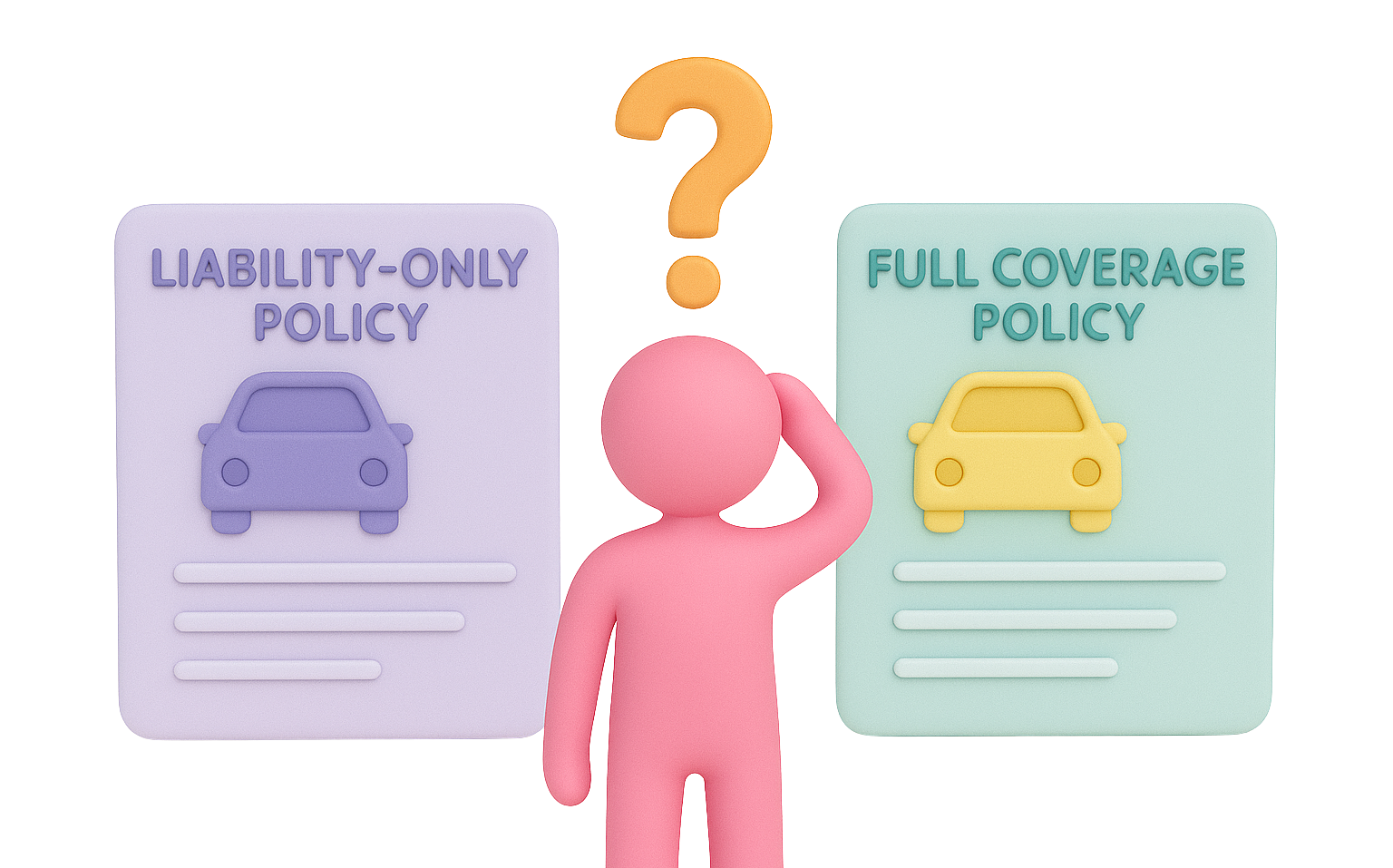


Should you pay extra for full coverage, or is liability-only insurance enough? It’s one of the most common questions drivers face. Full coverage costs more than liability-only, but it also provides significantly more financial protection. Our customers pay between $178 to $410 per month for full coverage, compared to $77 to $178 per month for liability-only.
This guide breaks down exactly what each type covers, what it costs and how to decide which one is right for you.

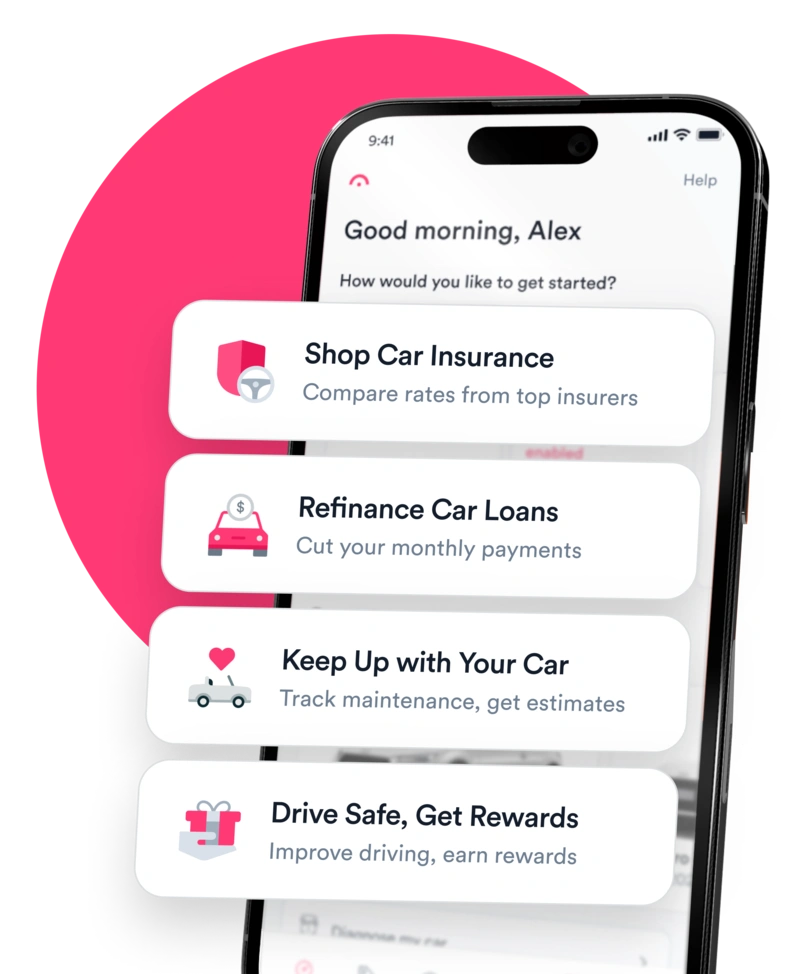
Jerry pulls up to 20 quotes from top rated carriers.
Liability vs. full coverage at a glance
| Liability-only | Full coverage | |
|---|---|---|
| Covers injuries and property damage to others | ✓ Yes | ✓ Yes |
| Covers damage to your own car | ✗ No | ✓ Yes |
| Required by law | ✓ Yes* | ✗ No |
| Required for loans or leases | ✗ No | ✓ Yes |
| Has a deductible | ✗ No | ✓ Yes |
*In all states except in New Hampshire
What is liability-only insurance?
Liability insurance covers damage and injuries you cause to others in an accident and is required in every state except New Hampshire. However, liability insurance doesn’t pay for damage to your own car.
Liability limits are expressed as three numbers, like 100/300/100. This means $100,000 per person for bodily injuries, $300,000 total per accident for injuries, and $100,000 for property damage.
Your car’s market value is less than $5,000.
You’re willing to pay out-of-pocket for your own car’s repairs after an accident.
Your car is fully paid off.
You rarely drive. Less time on the road means less risk for a crash.
Jerry recommends: Consider liability limits of at least 100/300/100. Getting just your state’s minimum limits may not be enough since one accident with injuries can cost over $160,000, according to the National Safety Council.
What is full coverage insurance?
Full coverage is a term used to describe a car insurance policy that includes liability insurance plus collision and comprehensive coverage. It pays for injuries and property damage you cause to others, plus damage to your own car.
Full coverage includes a deductible, which is the amount you pay before your insurer covers the rest of your car’s damage.
Have a car loan or lease. Lenders require full coverage if you do.
Drive a car with a market value above $5,000.
Can’t afford to replace your car out of pocket if it’s totaled.
Live in a high-risk area for theft or severe weather.
Drive frequently or in heavy traffic. More driving means more accident risk.
Drive a car with expensive parts.
Key takeaway: Full coverage combines liability, collision and comprehensive insurance to protect both others and your own car. It’s required if you’re financing or leasing, and recommended if your car is worth more than $5,000.
Use Jerry to compare liability-only and full coverage quotes
Not sure whether liability-only or full coverage is right for you? Jerry makes it easy to compare both options side-by-side. You’ll be able to see exactly how much you’d save with liability-only, or how much more protection you’d get with full coverage.
Jerry shows you up to 20 quotes from top insurers in minutes. Compare car insurance quotes now to find the best rates with the right coverage for your financial situation.
Find insurance in your state









How each type works in an accident
Here’s an example of how a liability-only policy would work after an at-fault car accident.
Here’s how full coverage would work after the same accident.
Key takeaway: In an at-fault accident, full coverage limits your car repair costs to your deductible. With liability-only, you’d pay for your own car’s repairs entirely.
Other coverages worth considering
Whether you choose liability-only or full coverage, these additional coverages can fill important gaps in your policy.
Here are some tips for choosing the right coverage:
💵 Know your car’s value. You can check your car’s market value with Kelley Blue Book.
🔍 Compare quotes from multiple insurers. Rates vary dramatically between companies for the same coverage. Compare quotes with Jerry to find the best rate for your needs.
📉 Review your coverage annually. Life changes like paid-off car loans, new drivers or moving can affect what coverage you need and what discounts you qualify for.
⭐ Research the best companies. It’s not just about price. The best car insurance companies offer great customer service for the coverage you need. You can read Jerry’s car insurance reviews to learn more about the insurers we work with.
Jerry recommends: Uninsured motorist coverage is worth considering, regardless of if you get a liability-only or full coverage policy. Without it, you’d pay for your own damages if an uninsured driver hits you.
Learn more: How much car insurance do I need?

It only takes 2 minutes to sign up at Jerry.
faq
- 🏦 Is full coverage actually required?
- ⚖️ What’s the minimum coverage I need to drive legally?
- 🔄 Does liability insurance cover me if I’m not at fault?
- 💵 At what car value should I drop full coverage?
- 🔒 What if I still owe money on my car but want liability-only?
Methodology
Statistics, rates and conclusions in this article are based on Jerry’s proprietary database of real-world car insurance quotes, not third-party models or estimates. As a licensed insurance broker in all 50 states, Jerry has firsthand visibility into how quotes are generated and validated, and all data is aggregated and anonymized to protect privacy.
With millions of quotes delivered each year (often multiple offers per driver), our datasets are large enough to avoid bias toward any one region, insurer or driver type. Unless otherwise indicated, quotes shown are from drivers with clean records in the last 12 months. Quotes involving accidents, violations or credit use the last 18 months to ensure a reliable sample.
Editorial integrity
We’re all about balanced, unbiased and helpful content at Jerry. None of our articles are sponsored by advertisers or insurance companies, so you can trust the information we provide. As a comparison platform that works with 100+ insurers, Jerry has no reason to favor one insurer over another. Our job is to help you find the best fit for your situation.
Read Jerry’s car insurance data methodology to learn more about how we collect, verify and share real-world insurance data.

Ben Moore is a writer and editor at Jerry and an auto insurance expert. He previously worked as a writer, editor and content strategist on NerdWallet’s auto insurance team for five years. His work has been published in The Associated Press, Washington Post, Chicago Sun-Times, MarketWatch, Nasdaq and Yahoo News. He also served as a NerdWallet spokesperson, with appearances on local broadcast television and quotes in Martha Stewart and Real Simple magazine.
Ben has an extensive background in digital marketing, working on affiliate and programmatic advertising campaigns for brands like Cabela’s, H&R Block and Sears. He holds a bachelors degree in marketing from Olivet Nazarene University.