This report was originally published in January 2024 and is being made available online in 2026 for archival reference; it was previously available only in PDF form. The data, statistics and predictions reflect the state of the American driver as of late 2023, a period shaped by the steepest car insurance rate increases since the 1980s, four-decade-high interest rates, cooling EV interest and a surging hybrid market. It has not been updated since the original publication date.
For our most recent findings, see the 2026 State of the American Driver Report.
Executive summary: Another challenging year, with reasons for cautious optimism
American drivers faced another challenging year in 2023. The cost of car ownership surged again, led by the steepest jump in car insurance premiums since at least the 1980s. Rising prices for new vehicles and interest rates sitting at four-decade highs kept many would-be buyers on the sidelines and punished those who jumped into the market. Owning a car forced more than half of American drivers to cut spending in other areas of their lives, while delinquencies and defaults on auto loans hit long-term highs, particularly among younger people.
Still, in a sign of optimism, more people plan to buy a vehicle next year as used car prices fall and economists predict interest rate cuts in the year ahead.
For the 2024 State of the American Driver report, Jerry surveyed more than 1,200 American drivers across all age groups and regions. We also drew on internal research on topics including insurance rates, road safety, and auto loan delinquencies. This year’s report offers insights into how the cost of car ownership is affecting Americans, their car-buying outlook, views on electric vehicles (EVs) and hybrids, and their experiences on the nation’s streets and roads.
Will 2024 be the year of stabilizing insurance rates? The resurgence of hybrids? Increased use and comfort with electronic monitoring of driving habits? Let’s dig in.
Key insights: The headlines from this year’s data
The 2023 data tells a story of split realities: rising costs continued to squeeze drivers, but a surge in car-buying intent suggests confidence is returning. The biggest shift, though, may be how Americans are thinking about their next vehicle, with hybrids overtaking EVs as the preferred path forward.
- 83% would choose a hybrid over an EV at the same price, no plug-in required.
- 41% are interested in an EV as their next vehicle, down from 49% last year.
- 58% cut spending elsewhere (meals, clothing, groceries) to afford their cars.
- 22% bought less car insurance coverage than they wanted in 2023.
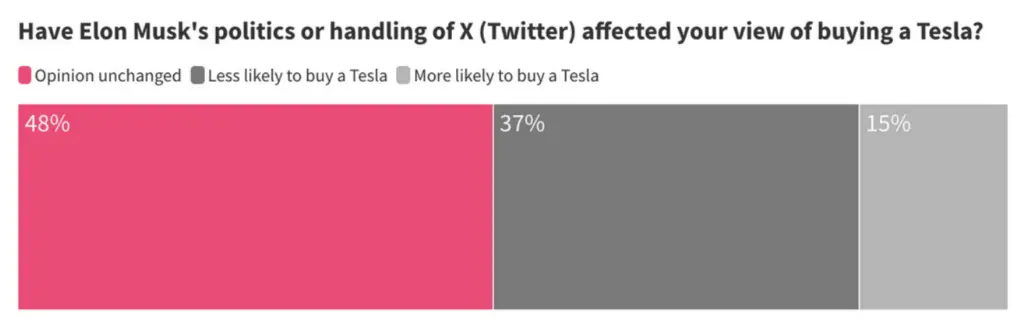
- 37% say they’re less likely to buy a Tesla because of Elon Musk’s politics.
- 56% say driving has become more dangerous in the past year.
Car buying: A buying comeback, despite high prices and rates
The supply-chain problems that roiled the new and used car markets in 2021 and 2022, sending prices of vehicles and parts sharply higher, were largely resolved by early 2023. But buying a vehicle remained painful for most Americans.
New car prices kept rising and, despite declining steadily over the past year, used car prices remain far higher than before the COVID-19 pandemic. Throw in the highest interest rates in four decades, and cars are increasingly unaffordable for the average American.
What’s on buyers’ minds
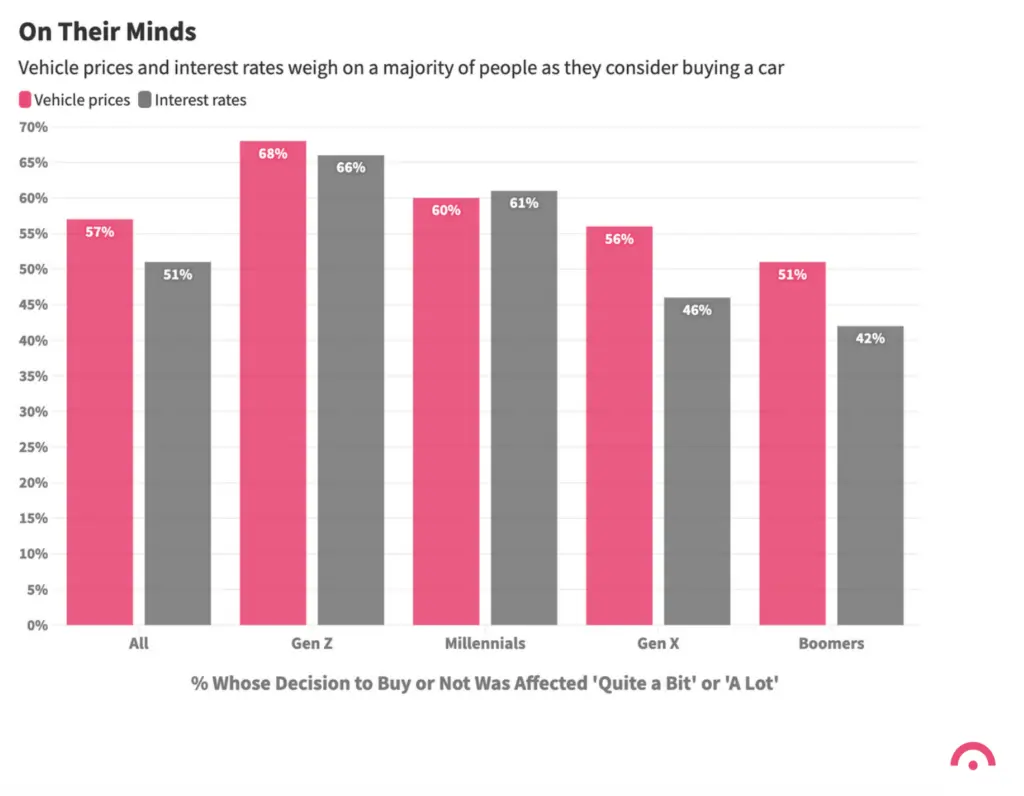
Both vehicle prices and interest rates weigh heavily on would-be buyers, but vehicle prices were the more frequent concern across every generation — except Gen Z, where interest rates and prices were nearly tied.
Buying intent doubles
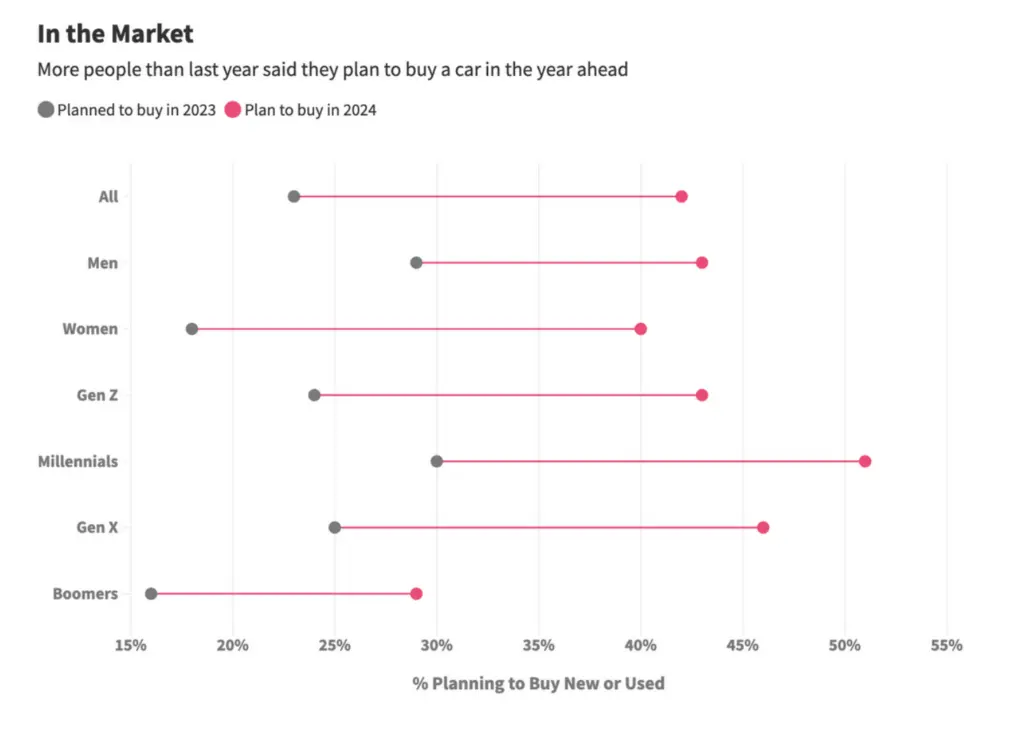
With the battle against inflation nearly won, the U.S. Federal Reserve is expected to begin cutting interest rates as soon as the first half of 2024. The economy remains on solid footing, boosting confidence that the U.S. will avoid a severe recession. All of which likely explains why the percentage of people who expect to buy a vehicle in the year ahead nearly doubled, to 42% from 23%.
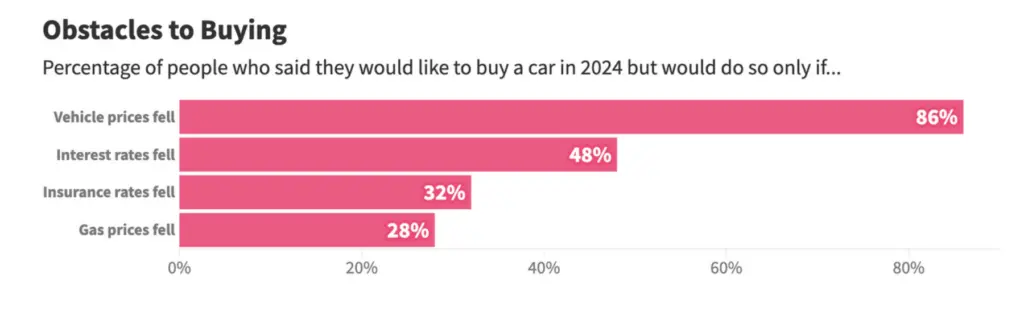
Obstacles to buying
Prices and interest rates remain obstacles for many. Of the 26% of respondents who said they don’t plan to buy a car in 2024 but would like to do so, 86% said lower prices would change their mind, while 48% said lower interest rates would.
The Amazon factor
The business of selling cars faces a potential shake-up in 2024, with Amazon planning to let people shop for vehicles available in their area on its site. More than half (57%) of respondents said they would consider buying a car on Amazon, compared with 31% who said a year earlier that an online platform would be their preferred method of buying a vehicle.
Cost of ownership: The 10% to 15% rule is breaking down
COVID-fueled inflation made the average American’s struggle to afford a reliable vehicle more difficult, sending prices and interest rates sharply higher after years of mostly flat vehicle prices and rock-bottom rates. Now, many Americans are ignoring (out of necessity) financial advisers’ rule of thumb that you shouldn’t spend more than 10% to 15% of your after-tax income on a car payment.
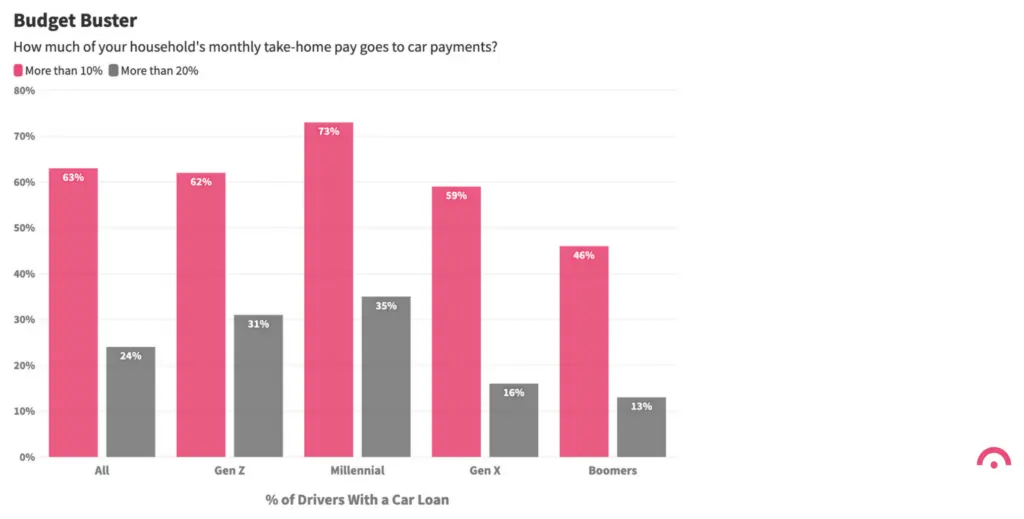
How much of take-home pay goes to car payments
In 2023, nearly two-thirds (63%) of Americans with a monthly car payment spent more than 10% of their after-tax household income on car payments, including 24% who spent more than 20%. Millennials spent the biggest chunks of their paychecks on car loans, with more than a third (35%) shelling out greater than 20% of their take-home pay.
The balancing act
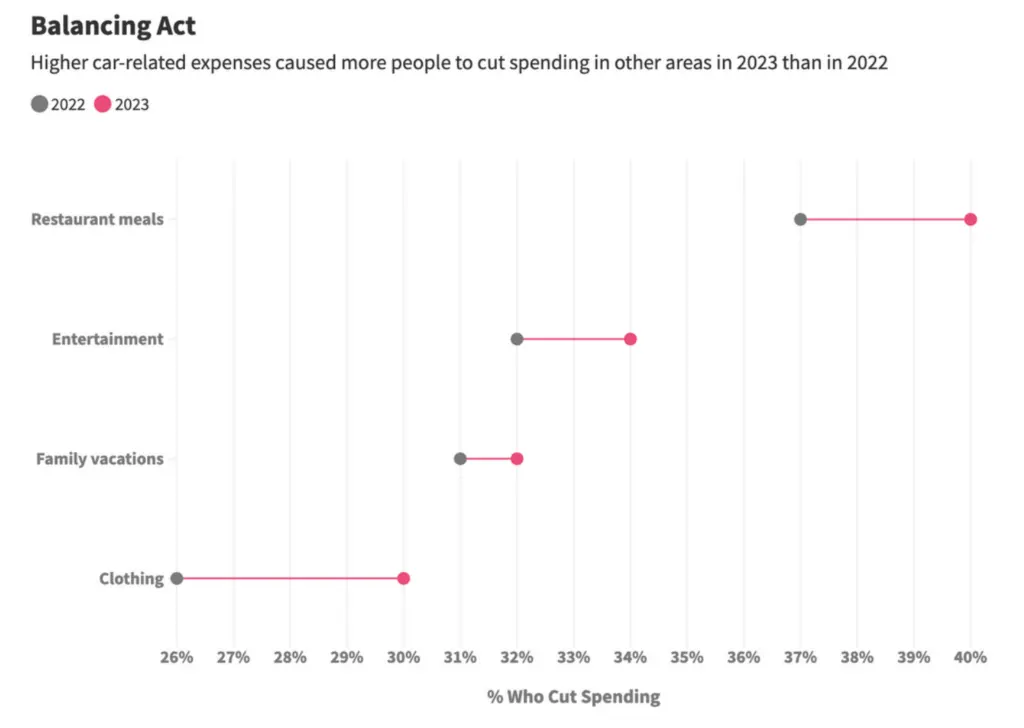
Car expenses don’t stop with the purchase price or monthly loan payment. The cost of repairs is up 13% from a year earlier, while insurance premiums have jumped 19% — the biggest increase of any car-ownership expense. That means difficult choices for most families in a year when inflation remained elevated and wages failed to keep up with price increases.
More than half of Americans (58%) reported cutting expenses in other areas of their lives to pay for the rising cost of owning a vehicle. That included 80% of Gen Z respondents and 69% of Millennials. And 30% of respondents said they would be unable to pay for a $500 unexpected repair job with savings.
Insurance: Premiums soar, drivers buy less
Car insurance premiums inflicted plenty of pain on drivers in 2023. Nearly three-fourths of Americans say car insurance is becoming unaffordable for the average person or family. As premiums rose, the solution for many was simply to buy less.
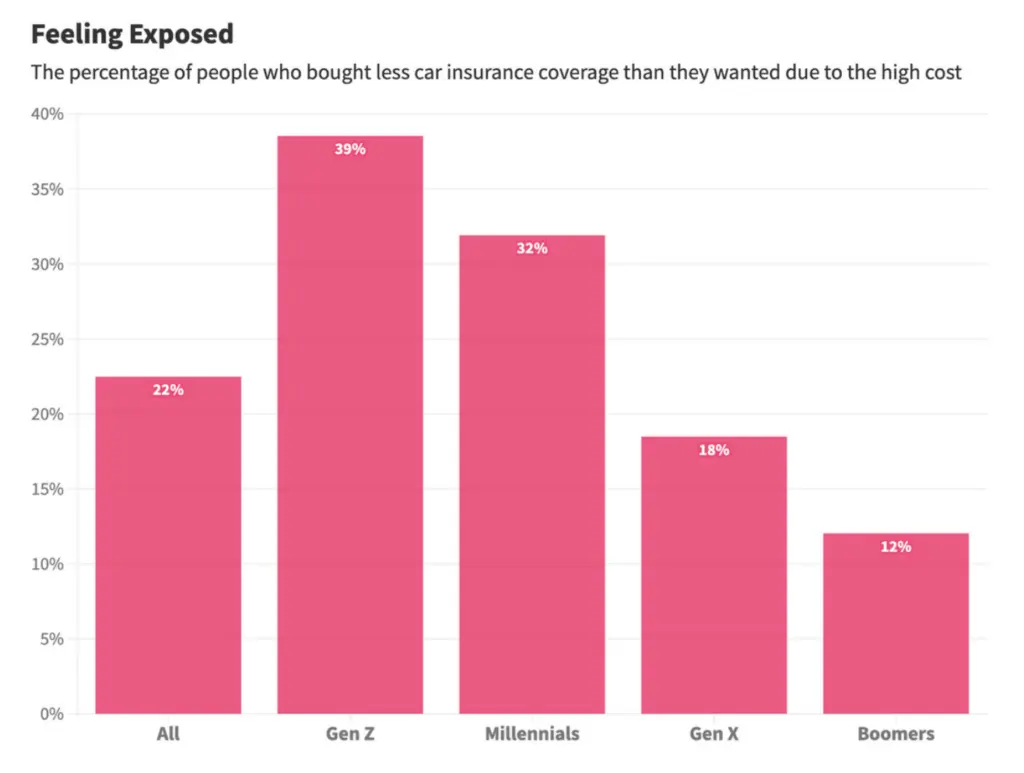
Buying less coverage to cope
More than one in five (22%) American drivers said they bought less coverage than they wanted in 2023. That included 39% of Gen Z drivers and 32% of Millennials, younger generations who are already stretched thinnest by car payments.
Despite soaring premiums, only 38% of all respondents said they shopped around for car insurance in 2023, up just barely from 37% last year. Yet our customer data shows that 60% of people who shop for a lower price on car insurance end up saving money through Jerry.
Telematics: a complicated bargain
More than half (54%) said they would be willing to let their insurance company monitor their driving electronically in exchange for the possibility of a lower premium. But about half (52%) also said they would consider switching insurers if their current insurer required them to agree to electronic monitoring.
– As inflation declines and insurers see increases in their average premium, loss ratios should start to meaningfully decline. As more insurers re-enter markets they had limited (like California), customers should see more choices and competitive pricing.
– Driving data could become the single most important pricing factor. More insurers will use telematics to attract drivers with opt-in discounts.
– Bundling home and auto with the same insurer will likely be more challenging in 2024; the odds of finding a better policy by separating them will increase.
– By mid-2024, the market will mostly stabilize with most insurers properly priced and looking to grow. Continued large renewal rate increases are expected to drive record levels of shopping and switching.

Electric vehicles and hybrids: The year EVs cooled and hybrids took the lead
The growing enthusiasm toward EVs cooled in 2023 while interest in hybrids heated up. New EV models piled up on dealer lots as sales failed to meet expectations, despite a flurry of price cuts and a new federal tax credit that made EVs more affordable than ever. By the end of the year, multiple automakers had delayed planned EV-related investments and the introduction of new EV models as analysts speculated that mass adoption in the U.S. had hit a speed bump.
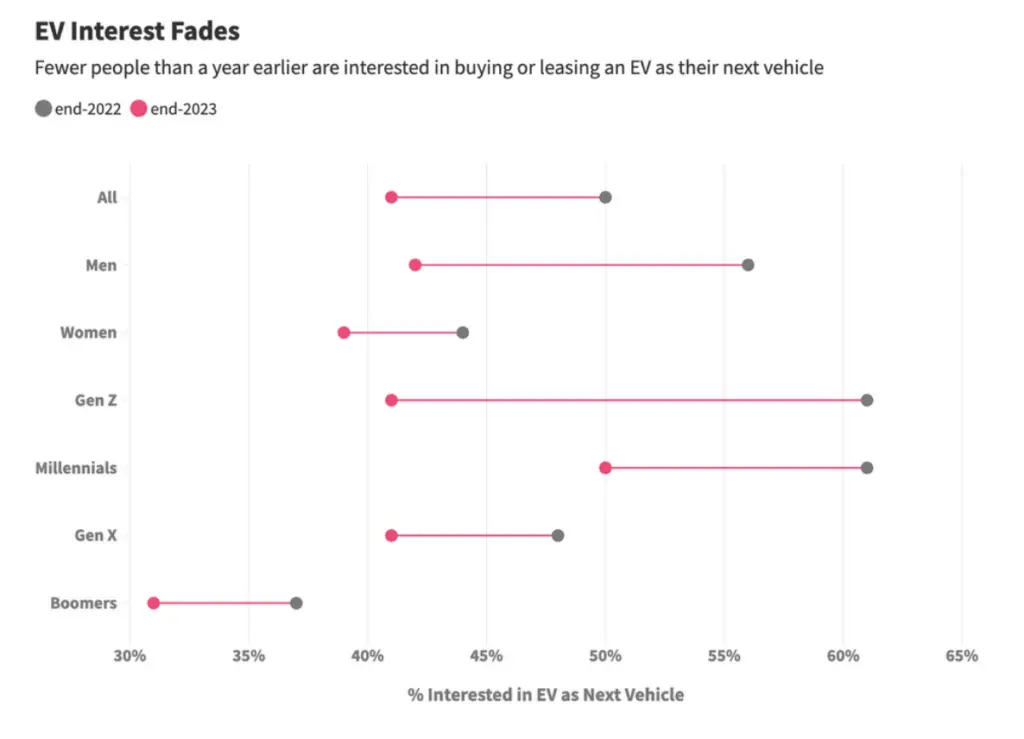
EV interest fades
The number of people who said they were interested in buying or leasing an EV as their next vehicle dropped from a year earlier. The steepest decline was among members of Gen Z, from 61% to 41%. Only Boomers expressed less interest (31%) than Gen Z.
What’s holding people back
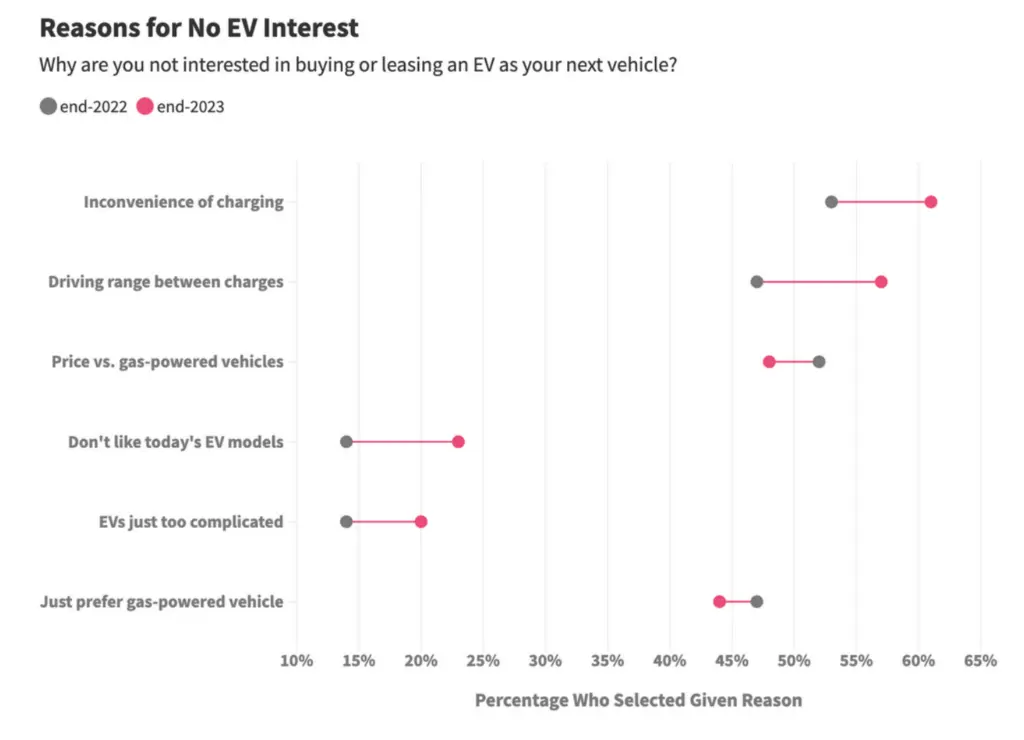
EVs are still more expensive than gas-powered cars and hybrids, though the differences narrowed after this year’s EV price cuts. But the inconvenience of charging a fully electric vehicle and those vehicles’ limited driving range remain the top obstacles for a majority of drivers — and those concerns have grown over the past year.
The resistance runs deeper than logistics, though. More than half (54%) of car owners not interested in an EV said they wouldn’t consider one even if charging were as quick and convenient as filling up with gas. Nearly half (44%) said they simply prefer a gas-powered car.
Why those still interested want an EV
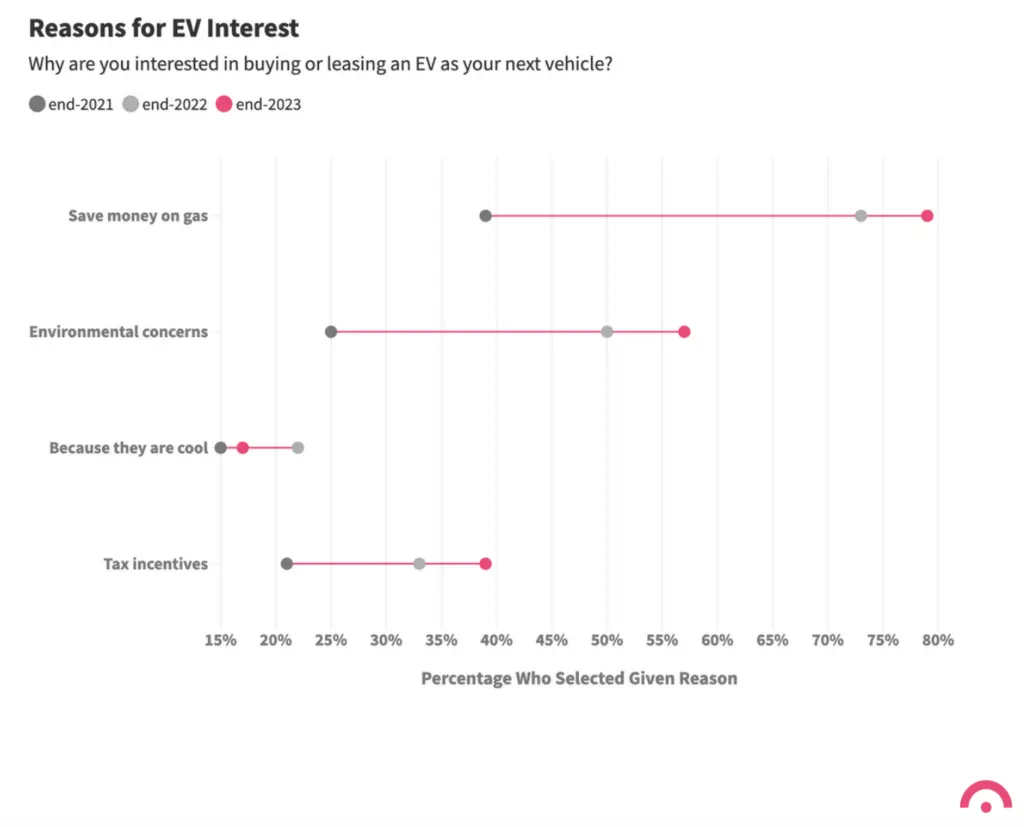
Saving money on gas remains the biggest motivator for those who are interested in an EV as their next vehicle, and it’s grown more dominant. Environmental concerns run a distant second, while interest in EVs because they’re “cool” has flatlined. With gas now around $3 a gallon after hitting a record $5 in summer 2022, it’s little surprise that fewer people overall see an EV as their next vehicle.
The hybrid resurgence
Concerns about driving range and charging needs help explain why hybrid sales were on pace to top EV sales in 2023, just a year after EV sales beat hybrids for the first time ever. Both Toyota and Ford expect to quadruple their hybrid sales over the next five years, and Honda plans to expand its hybrid offerings.
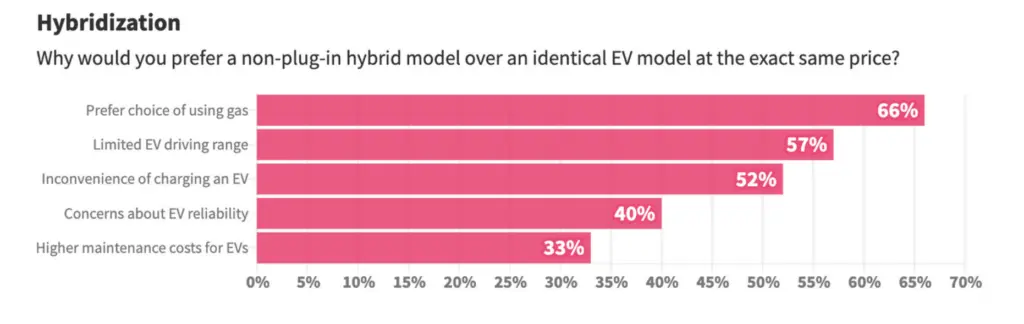
It’s not just that EVs are more expensive. When asked to choose between two hypothetical identical vehicles at the same price — a hybrid that doesn’t require charging and an EV that does — 83% chose the hybrid, even at the same price.. The most frequently cited reason (66%) was the option to use gas, followed by limited EV driving range (57%) and inconvenience of charging EVs (52%).
The home charging gap
With public charging infrastructure still sparse, especially outside the biggest EV markets, there is far greater interest in EVs among people who can install a charger at home. Those who have a place to install a charger at home were about twice as likely to express interest in buying an EV as their next vehicle, and twice as likely to say they expect to buy their first EV within the next three years. Those without were nearly twice as likely to say they never plan to buy an EV.
The Elon Musk factor
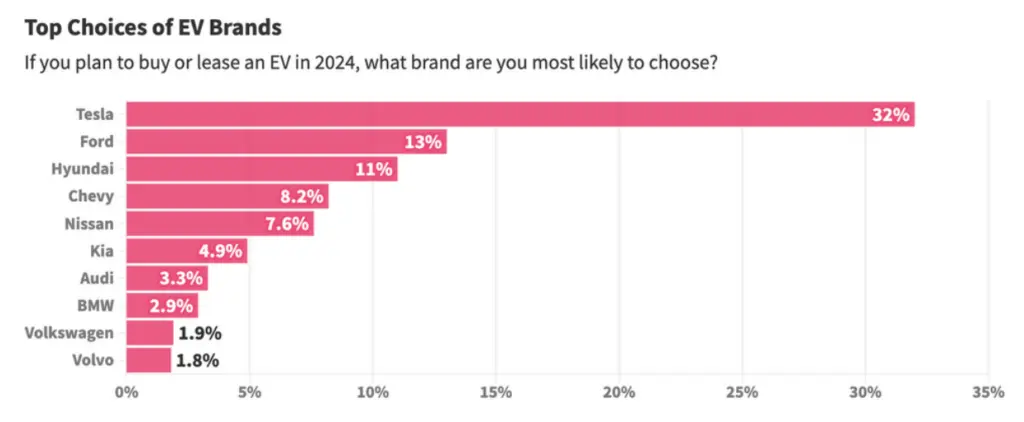
Tesla remains the brand of choice among people interested in buying EVs, but its dominance continues to wane as more automakers introduce new EV models. Ford, Hyundai, Nissan and Kia all gained ground among survey respondents since last year.
Elon Musk’s purchase of X and his political views probably aren’t helping Tesla’s sales. More than a third of American drivers (37%) who said they would consider an EV for their next vehicle also said they are less likely to buy a Tesla because of Musk’s politics and management of X, while 15% said they are more likely to buy a Tesla.
Driver safety: A road safety crisis on America’s streets
The U.S. faces a road safety crisis. Traffic fatalities jumped 18% from 2019 to 2022, the most recent year for which data is available, as fatal crashes involving speeding rose 21%. The number of people killed who weren’t wearing a seat belt rose 17% during the same time frame, and the number of drivers involved in fatal crashes who were under the influence of alcohol, drugs, or medication jumped 30% from 2019 to 2021. Meanwhile, the number of road rage shootings more than doubled from 2019 to 2022.
What drivers are seeing
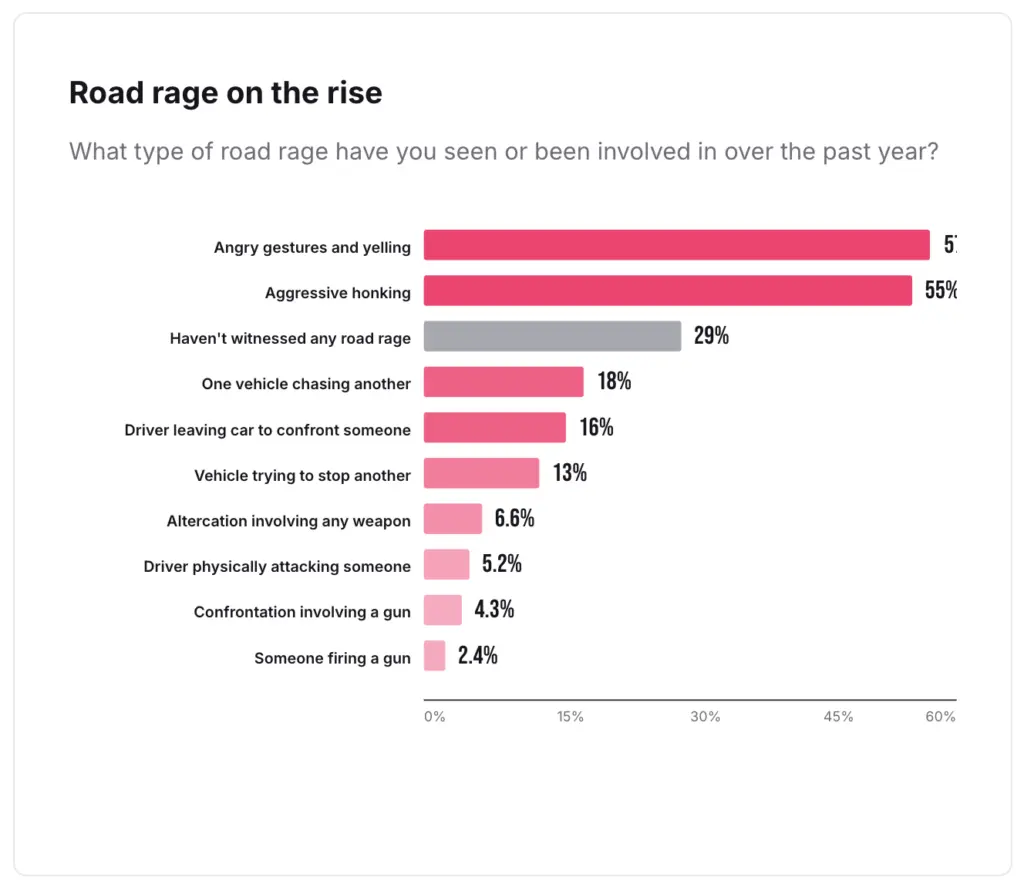
More than half (56%) of American drivers said driving has become more dangerous in the past year, while fewer than one-third (29%) said they didn’t witness or weren’t involved in any road rage incidents. More than one in 10 (13%) said they witnessed one vehicle try to stop or block another, 5.2% said they saw a driver physically attack someone, and 4.3% said they saw a confrontation involving a gun. Six percent said they sometimes keep a loaded handgun within reach while driving and 27% said they know someone who does.
Speeding scofflaws
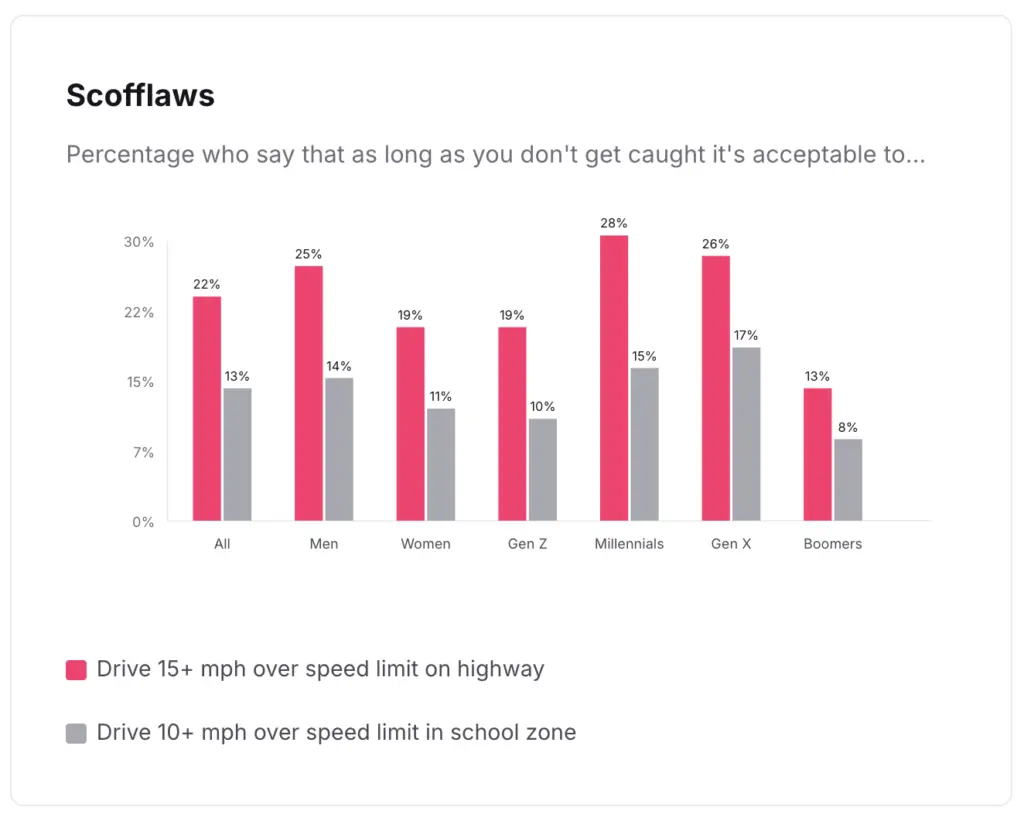
Attitudes toward speeding may help explain the rise in fatal crashes. More than one in five drivers (22%), including a quarter of men, said it’s acceptable to drive 15 mph or more over the speed limit on a highway if you don’t get caught. That included 28% of Millennials and 26% of Gen X. Another 13%, including 17% of Gen X, said it was acceptable to drive 10 mph or more over the speed limit in a school zone.
Conclusion: A more hopeful (but still expensive) year ahead
While most American drivers again struggled with surging car-ownership costs in 2023, falling used vehicle prices and the promise of lower interest rates offer reasons to hope that the coming year will be at least a little easier. This is reflected in the growing number of drivers who say they plan to shop for a vehicle next year.
Getting them to buy an EV, though, remains a difficult sell for automakers who have poured billions into the new vehicles. Sales of EVs to early adopters may have reached a plateau, and with charging infrastructure still underdeveloped — especially outside the areas that have led the way in EV purchases — most Americans remain unconvinced that the value of owning an EV outweighs the risk and inconvenience.
Meanwhile, hybrids are poised to challenge EVs in the years ahead. Many car buyers are starting to see hybrids as a transitional solution: a way to save money on gas and reduce emissions while avoiding the higher price tag and potential headaches that come with buying an EV right now.
Methodology
Jerry’s 2024 State of the American Driver report is based on data from a nationally representative survey of 1,268 people conducted in November and December 2023 using a platform and audience from Pollfish.
Results were filtered to include only respondents who own or lease a vehicle and drive at least once a week, and blended for age, gender, and region. More information about Pollfish and its audiences can be found on its website.
Data on fatal traffic crashes comes from the National Highway Traffic Safety Administration, and figures on road rage shootings are from Everytown for Gun Safety, which analyzed data from the Gun Violence Archive. Inflation figures are based on data from the U.S. Bureau of Labor Statistics.