

This report was originally published in January 2022 and is being made available online in 2026 for archival reference; it was previously available only in PDF form. The data, statistics and predictions reflect the state of the American driver as of late 2021 — a period shaped by chip shortages, pandemic disruption and rising gas prices — and have not been updated since the original publication date.
For our most recent findings, see the 2025 State of the American Driver Report.
Executive summary
American drivers are navigating a volatile automotive landscape with only one constant: change. At the start of 2022, drivers feel the impact of chip shortages, lack of inventory, high gas prices, inflation, and an ongoing pandemic.
Jerry surveyed American drivers from all 50 states and analyzed results across generations and geographies in December 2021. Paired with business data from more than 1.5 million U.S.-based drivers, the Jerry 2022 State of the American Driver Report includes key insights on trends, predictions on adoption of new automotive technology, and a peek into current driving culture.
As the only super app for car ownership, Jerry is exploring the costs, burdens and desires of drivers to enhance its products that save Americans time and money on car-related expenses, which currently cost 20% of the average American’s income. In 2021, the company saved customers an average of more than $850 per year through its insurance compare-and-buy service.
Key insights: The headlines from this year’s data
- The majority (58%) of American drivers are considering selling their car in 2022.
- One in 4 Americans plan to car shop in 2022, adding pressure to a fragile market.
- Half (50%) of Americans have never used a ride-hailing app like Uber or Lyft.
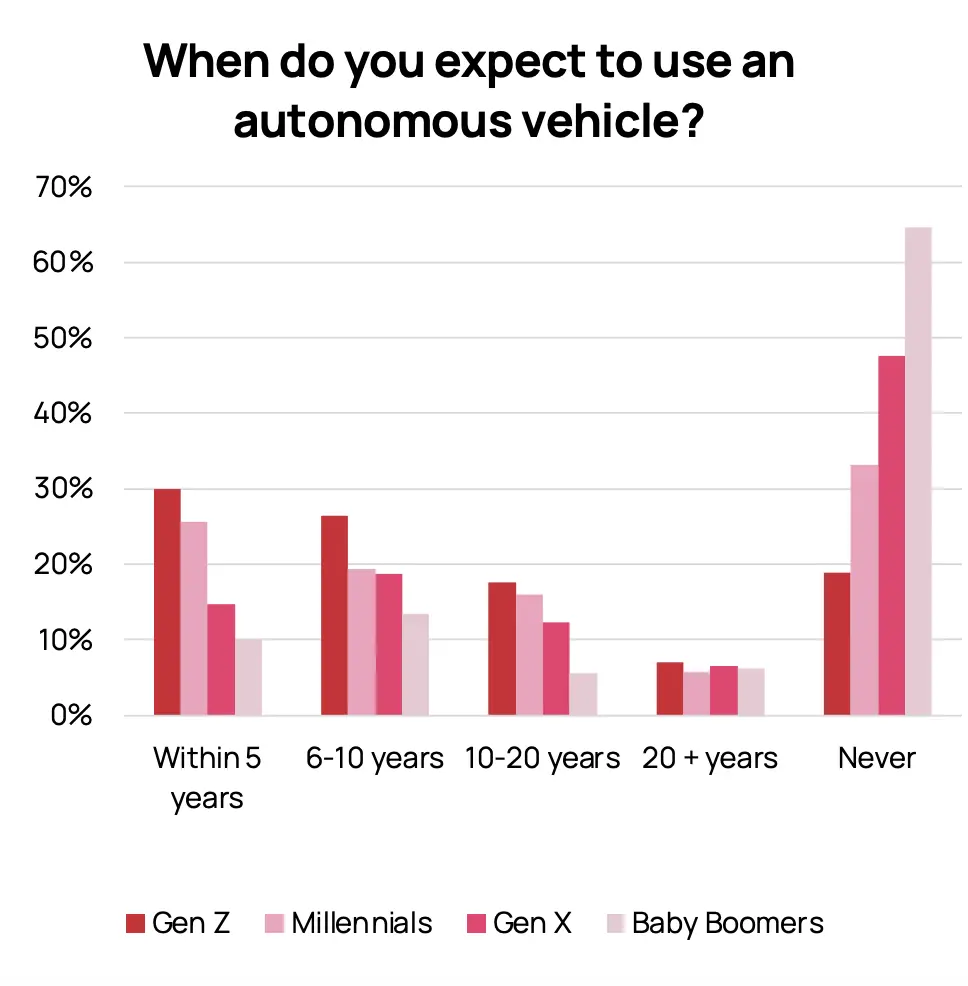
- Many (40%) of drivers never expect to use an autonomous vehicle.
- A third (33%) of Americans never expect to drive an EV in their lifetime.
- Nearly half (44%) of those who drove instead of flew in 2021 plan to return to air travel in 2022.
Below, we dig into the data behind each of these findings and flag the surprises that emerged when we segmented results by generation, gender and region.
Car ownership today: A volatile market for buying and selling
A strong 14% of American drivers sold a car in 2021, and more than half (58%) are considering selling in 2022. Automotive manufacturers, dealerships, and consumers selling and buying will continue experiencing a volatile market. Chip shortages are predicted to continue through 2022, keeping new and used car prices high and dealerships shorthanded.
Why people sold in 2021
The number one reason for selling was wanting or needing to buy a new car (61%), followed by moving to an urban area, wanting to make money during a car shortage and financial needs (all at 18%). Other top responses included no longer needing to drive to work (12%), rising gas prices (10%) and environmental concerns (5%).
How they sold
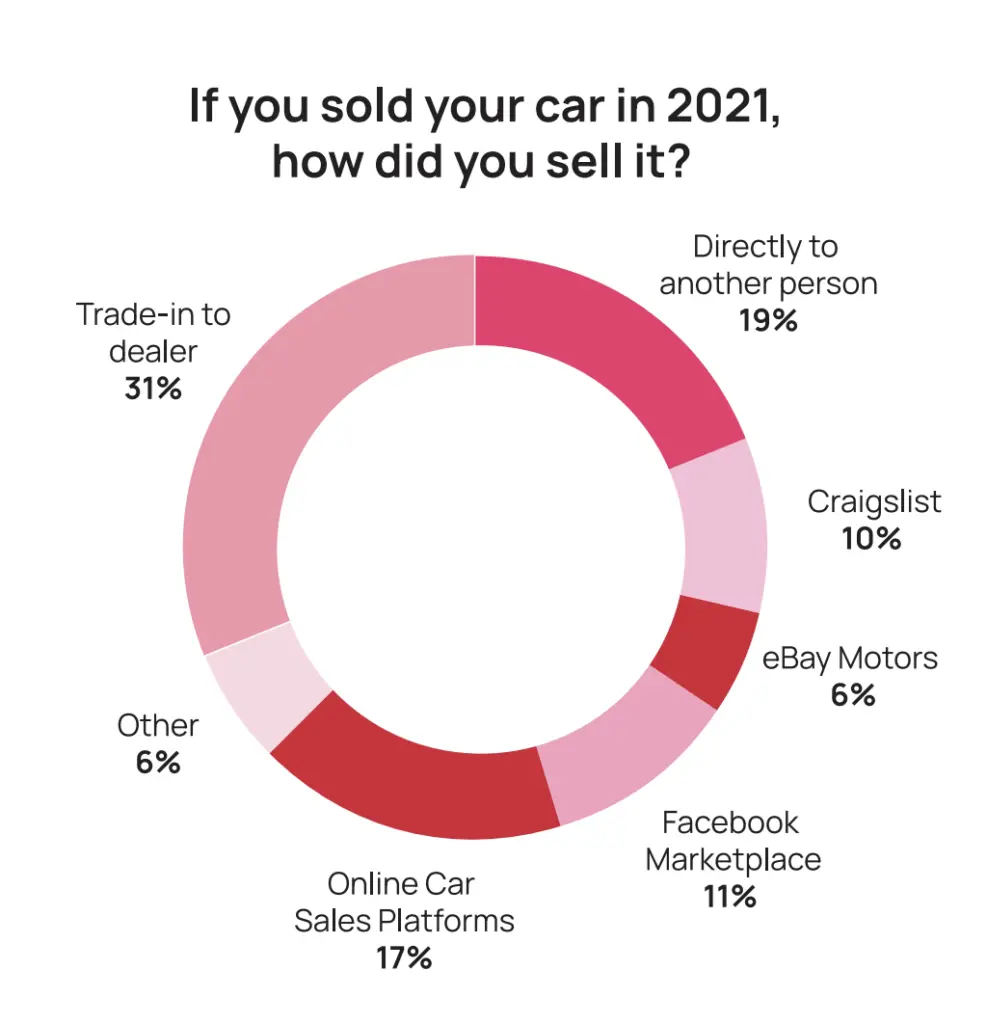
Nearly half (44%) of Americans sold cars via digital marketplaces. 17% reported selling through online car sales platforms (Cars.com, Autotrader, etc.), 11% used Facebook Marketplace, 10% used Craigslist and 6% used eBay Motors. Despite the smaller profit, 31% traded in through a dealership while just 19% sold directly to another person.
Surprising finding: Baby Boomers were most likely (60%) to opt for dealer trade-in. But digital car sales transactions are attractive to most. Women were 3x more likely to sell on Facebook Marketplace than men in 2021.
Car buying plans
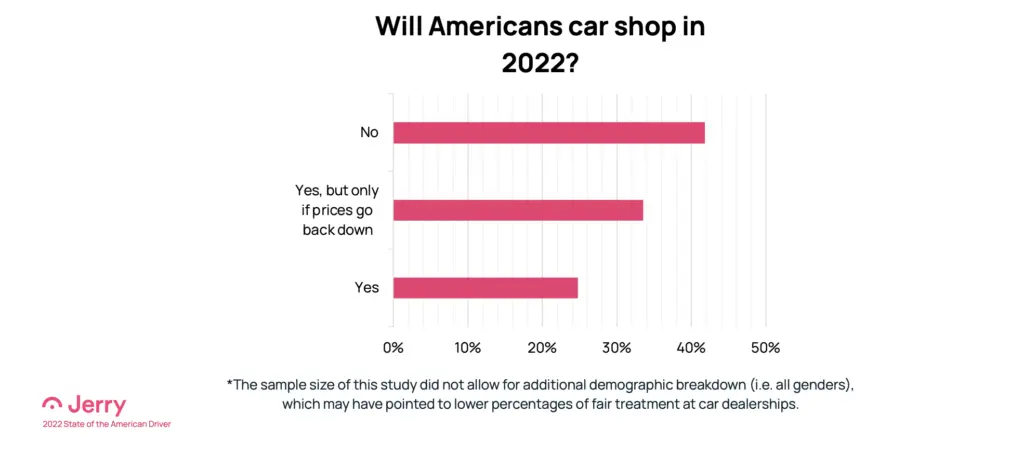
One in 4 Americans (25%) intend to car shop in 2022, a boon for automotive manufacturers, but one that may compound the new car shortage. Another 33% say they’ll start shopping if prices come back down, while 42% won’t shop regardless.
At the dealership
At car dealerships, 62% of Gen Z believe they will be treated fairly, followed by 60% of both millennials and Baby Boomers, and 49% of Gen X. Contrary to popular belief, women were slightly more likely (56.43%) to believe that they will be treated fairly at a car dealership than men (56.16%).
Travel by car: Long drives, slow flights and the return of the commute
Americans changed how they travel. In 2021, nearly half (49%) chose to drive long distances more often than flying because of COVID-19 fears. Trips that required flight were replaced by vacation destinations within driving distance, if not canceled altogether.
In 2022, as airlines ramp up, the world seems bullish on the return of travel. Yet only 44% of those who chose to drive in 2021 indicated they plan to fly more frequently this year.
Slow business travel comeback
The COVID-19 impact on business travel remains: 34% of Americans are less likely to drive for business travel than in previous years, citing video conferencing (19%) and other forms of transport (15%) as reasons.
Commuting now vs. pre-pandemic
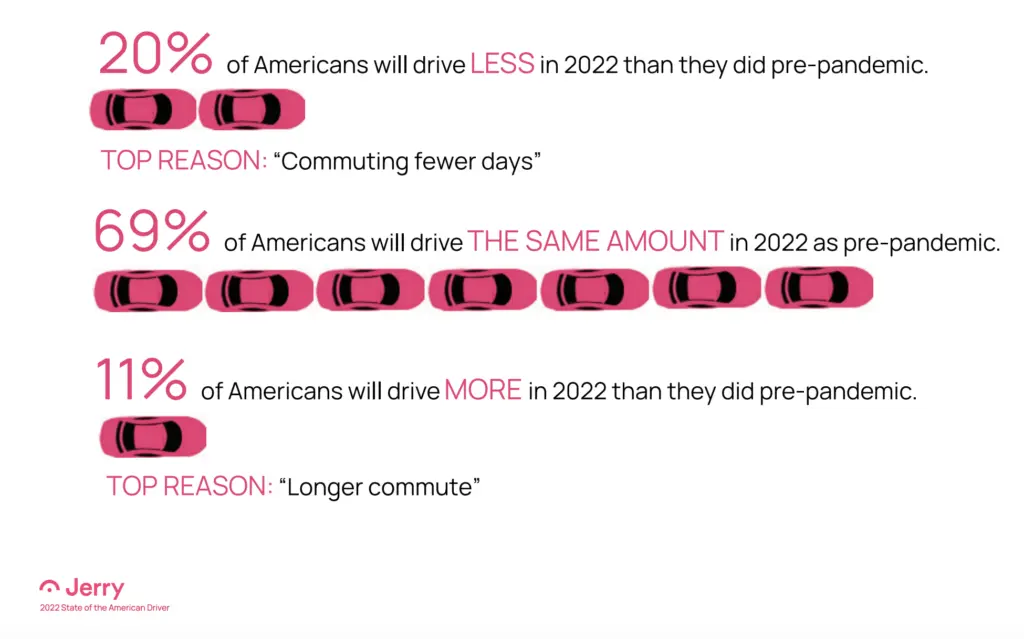
Commuting cost has increased for some. The leading reason for higher commute costs was more expensive gas prices (34%), while the top reason for a decrease was simply commuting less (14%). 33% said the cost of their commute has not changed.
Half of driving Americans still don’t ride-hail
The ride-hailing market has substantial room for growth. Half (50%) of drivers had never used a ride-hailing app (Uber, Lyft, etc.), but 1 in 10 drivers were frequent users, with 12% ride-hailing once a week or more.
Generational gap is dramatic: 72% of Baby Boomers had never used a ride-hailing app, compared to 58% of Gen X, 37% of Millennials and 36% of Gen Z.
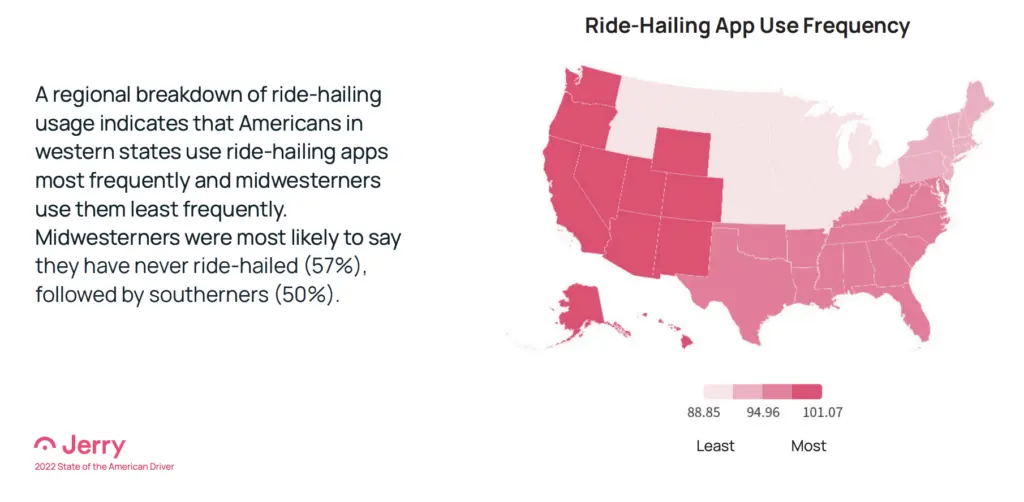
Midwesterners were most likely to say they have never ride-hailed (57%) followed by southerners (50%).
Electric and autonomous vehicles: Drivers want EVs to save money, not the planet
Electric vehicle (EV) ownership is undoubtedly on the rise, though for unexpected reasons. Less than 1 in 10 Americans (8%) reported already driving an EV near the end of 2021. Today, Gen Z drivers are most likely to be behind the wheel of an EV (18%), followed by Millennials (11%), Gen X (4%), and Baby Boomers (1%).
Who’s most eager to go electric
As manufacturers invest in EVs, half of Americans expect to be driving one in the next 10 years. Still, nearly one third (32%) said they expect to drive gas vehicles forever, and older generations are not entirely responsible. Nearly one quarter (24%) of Gen Z drivers never expect to drive an EV, despite having many decades of driving ahead of them.
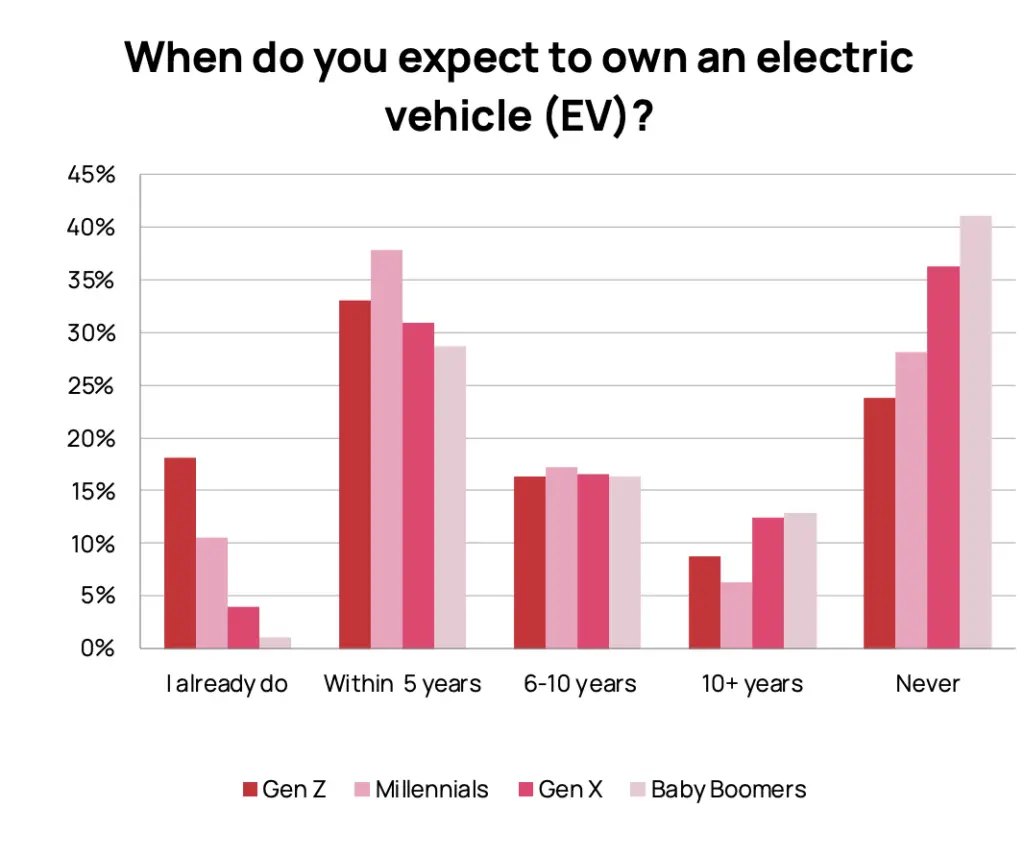
Men were more interested in buying an EV as their next car at 43% compared to 36% of women.
Money beats the environment
While most Americans say they would support policies that address climate change, they appear more motivated by money. The number one reason Americans are interested in buying an EV is gas expense savings (39%).
But do drivers recognize the short-term higher costs of EVs? In 2021, EV prices were on average $11,000 higher than full-sized gas-powered cars. While EVs may save drivers on gas, Jerry data indicates EV drivers may pay more elsewhere — for example, EV drivers paid on average $214 per month for car insurance vs. $156.50 per month to insure gasoline-powered vehicles.
Generational surprise: Baby Boomers were the only generation to choose concern for the environment as their top motivation to purchase an EV (38% vs. 37% who cited gas savings). And Gen Z was the only group whose primary interest in driving an EV was because they are “cool” (32%).
Autonomous vehicles: 41% say “never”
Many Americans are not sold on autonomous vehicles. 41% never expect to use a fully autonomous vehicle, yet 39% expect to within 10 years. Surprisingly, 19% of Gen Z drivers — many with 50 or more years of driving ahead of them — said they never expect to use one.
Still, the youngest driving generation is most confident in the near-term success of autonomous vehicles. Gen Z drivers were most likely to say they expect to use a fully-autonomous vehicle within five years (30%). All other generations were most likely to say they never expect to use one: Millennials (33%), Gen X (48%), and Baby Boomers (65%).
Driver behaviors and perceptions: Confident, assertive and surprisingly polite in the West
How Americans see themselves behind the wheel reveals as much about generational identity as it does about driving skill. We asked drivers to rate their own ability, name the best driver in the family and tell us how often they lean on the horn — and the answers split sharply along lines of age, gender and geography.
Driver confidence
Most American drivers are confident. Nearly half (46%) rated themselves as “great drivers.” Gen X was the most confident generation, with 72% giving themselves top marks. Gen X men were most likely to rate themselves a great driver.
Counter to expectations, Gen Z and Millennials were least likely to rate themselves great drivers (40% and 54%). Overall, 69% of men rated themselves as great drivers compared to 44% of women. Among men, 46% thought their friends and family would rate them as great drivers, while only 31% of women thought the same.
In the family: 56% of Americans believe they are the best driver in their immediate family, followed by 15% who chose their spouse or significant other, 11% chose their father, 10% chose their mother, and 8% chose their siblings.
Younger drivers wait, but honk more
Over 70% of Baby Boomers and 66% of Gen X got their driver’s license the first year they were eligible, while just over half of Millennials (54%) and Gen Z (53%) said the same.
Once they start driving, younger generations are more assertive (and maybe less polite). 14% of Gen Z and 15% of Millennials said they honk daily, compared to 8% for Gen X and 4% of Baby Boomers. Confirming stereotypes, East Coasters are more than twice as likely to honk daily (14%) than West Coasters (6%).
Cars as status symbol, by generation
The older you get, the less likely you are to view a car as a status symbol. Overall, one third (35%) of Americans see cars that way — but the gap between Gen Z and Baby Boomers is striking.
-
50% of Gen Z
-
44% of Millennials
-
29% of Gen X
-
19% of Baby Boomers
Driver life skills
Are Americans becoming worse drivers, or is the road test getting harder? A whopping 73% of all Americans passed their road test on the first try, while 19% failed once. The first-time pass rate has decreased over the years: 85% for Baby Boomers, 78% for Gen X and 64% for both Millennials and Gen Z.
And if you need to change a tire? Find the nearest Gen X-er. A strong 81% of Gen X drivers know how to change a tire without help from the Internet or manual, followed by 72% of Boomers, 65% of Millennials and 52% of Gen Z. Most men (82%) claim to know how, compared to 58% of women.
Car insurance costs: What Americans paid in 2021
American women paid slightly less for car insurance in 2021 than men, at $152 per month vs. $159. However, when looking at insurance pricing along generational and gender lines, Millennial, Gen X, or Baby Boomer women may pay more than their generational male counterparts in 36 states.
Most expensive states
- New York: $355/mo
- Maryland: $247/mo
- Delaware: $242/mo
- New Jersey: $241/mo
Least expensive states
- Vermont: $87/mo
- Wisconsin: $90/mo
- Idaho: $91/mo
- Oklahoma: $92/mo
Average monthly cost by generation
- Gen Z: $183/mo
- Millennials: $151/mo
- Gen X: $132/mo
- Baby Boomers: $129/mo
Conclusion: Costs are up, drivers are adapting
American drivers are wary of increasing costs. As a result, many are driving less, some are waiting to shop, and others are considering EVs. Compared to pre-pandemic, Americans have changed how they commute daily — and they’re slow to return to air travel.
As costs across car ownership categories rise, from insurance and vehicle prices to gas expenses and beyond, Jerry is on a mission to save customers time and money across the board.
Methodology
The Jerry 2022 State of the American Driver report analyzed data from a nationally representative survey of 1,250 respondents conducted and analyzed in December 2021 using a SurveyMonkey Audience.
Survey respondents consisted of Americans ages 16–75 that drive at least once per week. Ages were broken down as Gen Z (16–24), Millennials (25–40), Gen X (41–56) and Baby Boomers (57–75). Results were balanced for age, gender and state.
Jerry also analyzed proprietary business data from more than 1.5 million U.S.-based drivers to better understand car insurance trends nationwide.